The Hudson Hangover
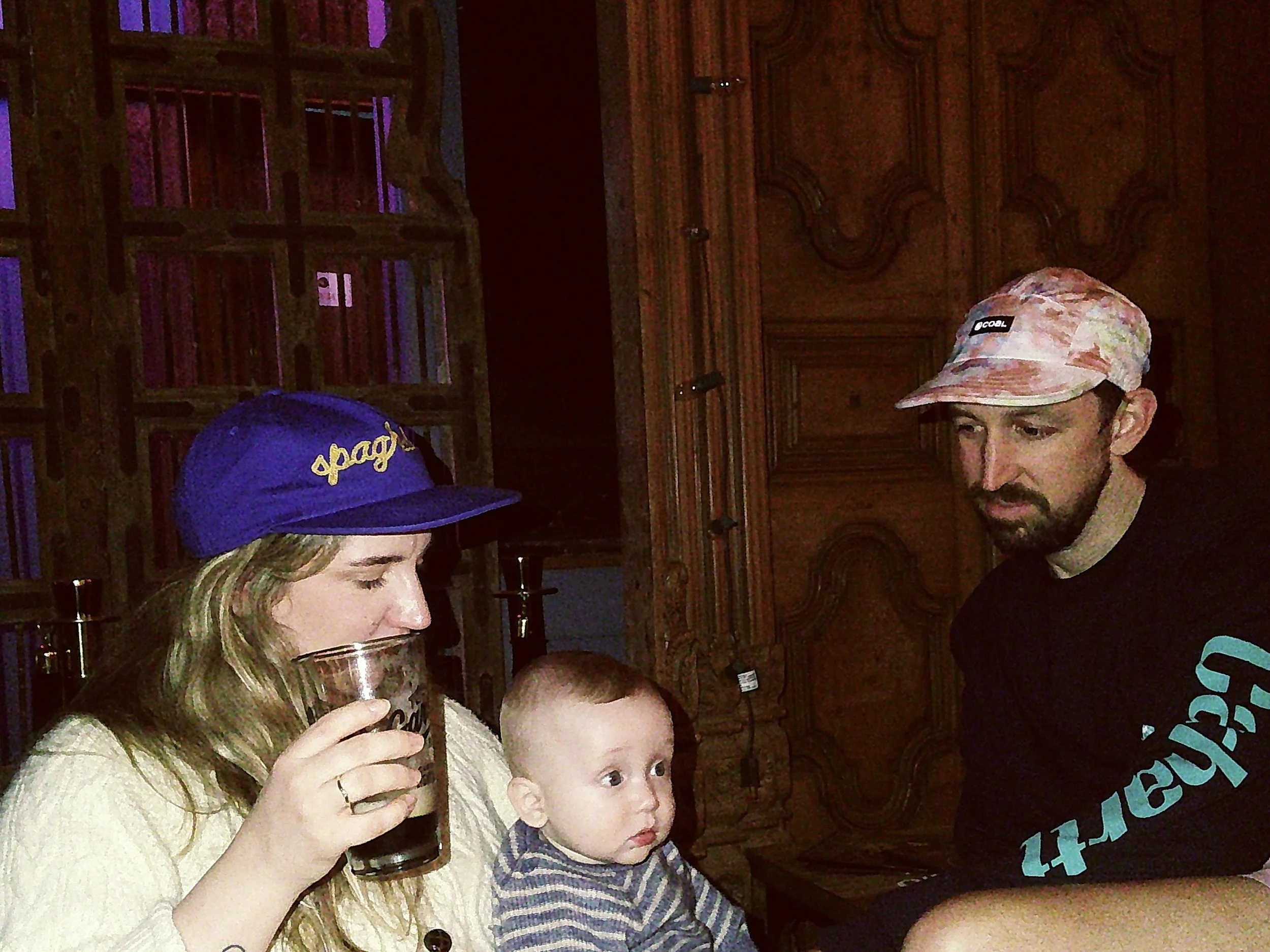
The Airbnb was the kind of place that made you briefly consider becoming the kind of person who says “Airbnb” like it’s a personality trait. It was a converted historic home, which meant that at some point in the past it had belonged to someone important or at least someone who owned multiple chairs. Now it belonged, temporarily, to Matt, Jamie, and their six-month-old son Charlie, who had already drooled on at least three surfaces that could be described as “original.”
The listing had promised “charming architectural details” and “proximity to the cliffs,” which turned out to mean exactly one block away from a dramatic drop into a gray, rain-churned river. It was the sort of view that suggested reflection, poetry, or at the very least a quiet moment of appreciation. Instead, it mostly suggested nausea.
Matt stood in the kitchen, which featured a farmhouse sink large enough to bathe a medium-sized dog, staring into a mug of coffee like it had personally betrayed him. He was tall and thin in the way that made hangovers feel like a structural failure. His Patagonia jacket was zipped halfway up, because even indoors he liked to be prepared for a spontaneous hike, or at least the idea of one.
“This house is judging me,” he said.
Jamie, who was five feet tall and offensively adorable despite looking like she hadn’t slept since the third trimester, sat on a vintage settee that probably had a name. She held Charlie, who was chewing on his own hand with the determination of someone who had discovered a new and exciting food group.
“The house is from the 1800s,” she said. “It has seen worse than you drinking two cocktails and a glass of wine.”
“It was more than a glass,” Matt said, wincing as if the memory had edges.
“Right,” Jamie said. “You ‘finished the bottle so it wouldn’t go to waste.’ A real environmentalist.”
Charlie made a series of delighted babbling noises, which sounded less like language and more like a running commentary on their poor decisions.
“Ba-ba-ba,” he said, which, given the circumstances, could reasonably translate to “You did this to yourselves.”
The rain tapped steadily against the tall, wavy-glass windows, the kind that made everything outside look like it was being viewed through regret. The cliffs, visible from the end of the block, loomed in a way that felt unnecessarily dramatic for 9:30 in the morning.
“We used to be good at drinking,” Matt said.
Jamie raised an eyebrow. “We were never good at drinking. We were just younger.”
Matt leaned against the counter, immediately reconsidering the decision. “I could drink and then run ten miles.”
“You could drink, sleep for nine uninterrupted hours, and then run ten miles,” Jamie corrected. “Now you drink, wake up at 3 a.m. because someone is practicing vowels, and then contemplate your mortality.”
Charlie squealed, as if proud of his role in this.
“He’s not even a little hungover,” Matt said, watching as Charlie grabbed his foot and examined it like a rare artifact.
“Of course he’s not,” Jamie said. “He’s powered entirely by milk and delusion.”
Matt nodded slowly. “I miss delusion.”
“You still have it,” Jamie said. “You booked this place thinking we were going to ‘cut loose.’”
Matt brightened slightly. “We did cut loose.”
Jamie looked at him. “You ordered a cocktail called ‘The Responsible Adult’ and then asked if it was too strong.”
“It had rosemary in it,” Matt said defensively. “That’s basically a garnish and a warning.”
The night before had been, by all accounts, an event. They had left the house—an achievement in itself—wearing clothes that suggested effort and optimism. Jamie had worn a dress that had been waiting patiently for a non-maternity moment. Matt had worn a flannel that implied he might, at any second, start discussing the various settings on his coffee grinder.
They had gone to dinner at a place where the lighting was low and the menu was high-concept. Words like “locally sourced” and “deconstructed” appeared with alarming frequency. At one point, Matt had said, “We should be more spontaneous,” which is exactly the kind of thing you say right before ordering a second drink you absolutely do not need.
Now, in the aggressively tasteful kitchen, spontaneity felt like a rumor.
“We should go to the cliffs,” Matt said, gesturing vaguely toward the window.
“In this?” Jamie said, nodding at the rain, which had settled into a steady, committed drizzle. Committed being the key word.
“It could be nice,” Matt said. “Moody. Reflective.”
“You’re already moody,” Jamie said. “And the only thing you’re reflecting on is how many ounces are in a standard pour.”
Charlie let out a happy shriek, as if to remind them that the day was still, technically, happening.
“He’s thriving,” Matt said.
“Of course he is,” Jamie said. “He went to bed at seven and woke up like he had something to prove.”
Matt sank into a chair that was probably older than his entire family line. “I feel like I’ve been hit by a very polite truck.”
“That’s called being in your late 30s,” Jamie said. “Your body sends you a handwritten note after every bad decision.”
Matt closed his eyes. “I think I need more coffee.”
“You’ve been thinking that for an hour,” Jamie said.
“I’m easing into it,” Matt said. “I don’t want to overwhelm my system.”
Jamie adjusted Charlie on her lap. “Your system is overwhelmed by existing.”
There was a brief silence, filled only by the rain and Charlie’s ongoing monologue.
“This was supposed to be fun,” Matt said.
“It is fun,” Jamie said. “This is just the part of fun that no one puts on Instagram.”
Matt looked around the room—the exposed beams, the carefully curated books no one actually read, the antique rug that now had a suspicious damp spot.
“We paid money for this,” he said.
“We paid money to be one block from the cliffs,” Jamie said. “So we could stand near a dramatic drop and think about how tired we are.”
Charlie laughed, a bright, uncomplicated sound that felt vaguely accusatory.
Jamie smiled despite herself. “Okay,” she said. “New plan.”
Matt opened one eye. “I’m afraid.”
“We’re going outside,” Jamie said.
“In the rain?”
“Yes. In the rain. Near the cliffs. Like the brochure wants.”
Matt sat up slowly, like a man reconsidering his life choices in real time. “With him?” he asked, nodding at Charlie.
“Yes,” Jamie said. “He has a rain outfit that cost more than one of your shirts. We’re using it.”
Charlie made an approving noise, which might have been agreement or just a vowel.
Matt sighed, then nodded. “Okay. But I’m bringing coffee.”
“Of course you are,” Jamie said. “It’s your emotional support beverage.”
They moved through the house with the careful deliberation of people who understood that sudden movements were no longer an option. Matt made the coffee, staring at the machine like it might offer him a second chance at life. Jamie found Charlie’s tiny rain jacket, which made him look like a very small, very confident lighthouse keeper.
By the time they stepped outside, the rain had softened into something almost gentle, like the sky was apologizing.
They walked the single block to the cliffs, Matt clutching his tin mug embrazzed with he AirBNBs logo, Jamie holding Charlie close. The river below churned in a way that felt unnecessarily dramatic for a Thursday morning.
For a moment, they stood there, looking out.
“This is nice,” Matt said, sounding surprised.
“It is,” Jamie said.
Charlie babbled happily, entirely unbothered by the concept of hangovers, cliffs, or expectations.
Matt took a sip of coffee and winced. “I still feel terrible.”
“You will feel terrible for a while,” Jamie said. “That’s the point. It’s called consequences.”
Matt nodded. “We used to be able to ignore those.”
“We used to be consequences,” Jamie said.
Charlie laughed again, as if confirming this.
They stood there a little longer, rain dotting their jackets, the house behind them quietly historic and unimpressed.
It wasn’t the getaway they had imagined. It wasn’t even the morning they had planned.
But it was something else—quieter, wetter, and significantly more honest.
And, annoyingly, it was still enough.